
For established B2B manufacturers, a website often serves as a digital placeholder rather than a dynamic engine for growth. This was precisely the situation for a leading North American blown film manufacturer and flexible packaging company. Despite their strong reputation and specialized capabilities within the industry, their online presence was significantly underdeveloped, failing to capture potential customers or generate any leads through their website.
Recognizing the missed opportunity, the company partnered with Redstitch Digital to overhaul its digital strategy.
A well-respected leader in the blown film and flexible packaging industry faced a common challenge among established manufacturers: its digital presence wasn’t contributing to business growth. Despite offering high-quality, custom solutions, the company’s website was outdated, lacked informative content, and failed to attract qualified organic traffic.
Critically, its previous website had never generated a single lead for the sales team. It existed merely as a digital brochure, failing to capture the interest of potential buyers actively searching online for the specialized capabilities the manufacturer offered. The company needed a strategic digital transformation to turn its website into a valuable business development tool.
Redstitch Digital partnered with the flexible packaging company to implement the agency’s signature foundational marketing approach, powered by AI insights and focused on sustainable, long-term growth. The strategy involved several key initiatives:
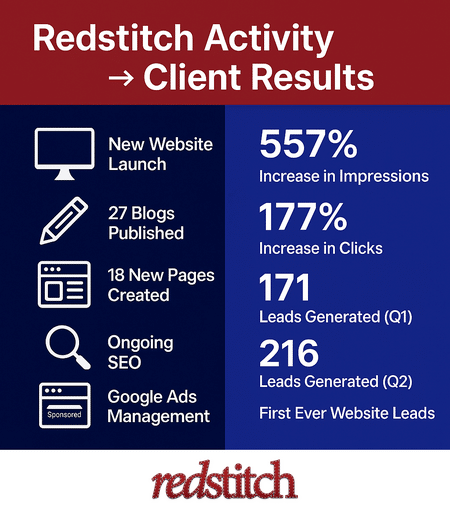
The impact of Redstitch Digital’s foundational marketing strategy was swift and substantial. By transforming the client’s online presence and consistently publishing valuable content, Redstitch Digital achieved remarkable growth in the client’s visibility and engagement:
This momentum continued to build, increasing to 216 conversions in the following quarter (September – November 2024) – a 26.32% quarter-over-quarter increase.
This engagement demonstrates the power of a strategic, foundational digital marketing approach for manufacturers. By combining a technically sound and user-focused website with consistent, high-quality content and ongoing SEO, Redstitch Digital transformed the client’s online presence from a non-performing asset into a lead-generation engine.
The dramatic increases in impressions and clicks, coupled with the generation of hundreds of conversions where none existed before, highlight the significant untapped potential that strategic digital marketing holds for businesses in the flexible packaging and manufacturing sectors. While the exact revenue impact is still being assessed internally by the client, the consistent flow of qualified leads represents a significant new channel for business development, directly attributable to the work performed by Redstitch Digital.
Is your manufacturing website underperforming? Contact Redstitch Digital today to learn how foundational marketing can generate leads and drive growth.
In July 2023, an education consulting company led by an inspiring keynote speaker approached Redstitch to revitalize their online presence and attract more qualified leads. The company struggled to compete online due to limited brand visibility and a lackluster digital strategy, losing market share to competitors with well-established websites. To address these challenges, Redstitch developed a comprehensive plan to strengthen the client’s content strategy, optimize their website pages, and use data-driven insights to enhance overall reach and engagement.
Redstitch’s proven approach was implemented for the customer, beginning with clear objectives and strategic planning:
1. Content Strategy Development
• Over the first 13 months, Redstitch published 63 blog posts centered on educational strategies and trends.
• Each post was crafted with relevant keywords and aligned with the keynote speaker’s philosophy, ensuring the content appealed to both human audiences and search engine algorithms.
2. StoryBrand Pages
• Redstitch developed multiple StoryBrand pages to highlight the core offerings of the consulting company.
• By focusing on the educator’s narrative and the transformational journey provided, Redstitch created a powerful emotional connection that resonated with prospects.
3. Data Utilization
• Performance metrics were tracked through Google Search Console, allowing Redstitch to refine strategies based on real-time insights.
• Keyword targeting, content adjustments, and ongoing optimization were guided by data, ensuring sustained improvement.
The results over approximately 7 months (from July 1st, 2023 to January 31st, 2024) were remarkable, showcasing the effectiveness of a consistent, high-quality content strategy combined with data-driven insights:
– Keyword Count Increase: 740% increase (+17,898 new keywords per month)
– Impressions: 563% increase (+267,578 impressions per month)
– Web Sessions: 834% increase (+21,019 sessions per month)
– Page Views: 714% increase (+27,096 page views per month)
– Leads Tracked: From unknown to 57 per month, with a positive trend
– New Users: 2,065% increase (+78,000 new users since July)

While average website conversion rates can vary by industry, Redstitch’s strategies focused on surpassing general benchmarks. Given that ecommerce conversion rates often range from 1.84% to 3.71%, and other industries average between 2.35% and 5.31%, the strong surge in traffic underscores a promising opportunity for even higher conversion gains.
A well-planned and executed marketing strategy can be the differentiator between a business’s success or failure. This is where marketing agencies come into play, acting as invaluable partners in propelling a business to new heights. In this blog post, we’ll demystify the world of marketing firms, discussing their roles, the various types of firms, and the comprehensive services they offer. We’ll also guide you on how to select the best firm for your business. Whether you’re looking for ‘the best marketing firms near me’ or ‘the best online marketing agencies,’ this guide has got you covered. So, buckle up as we take a deep dive into the dynamic world of marketing firms.
The role of marketing firms can’t be overstated in today’s business landscape. They play a crucial role in helping businesses reach their target audience, promote their products or services, and ultimately drive sales. The expertise and resources that a marketing firm brings on board can be instrumental in enhancing a company’s visibility and positioning in the market. Furthermore, they can provide valuable insights and strategic direction that can help a business to grow and succeed.
Marketing firms play a crucial role in helping businesses develop and execute effective marketing strategies to reach their target audience. There are three main types of marketing agencies: traditional, digital, and hybrid. Let’s explore each type.
Traditional marketing agencies focus on creating and executing marketing strategies and campaigns through traditional channels, such as print media, television, radio, and direct mail. These firms typically offer a range of services to help businesses reach their target audiences and promote their products or services effectively.
Examples of traditional marketing tactics used by traditional marketing firms include:
Staying ahead of the competition can feel like an uphill battle. One vital tool in this fight is a strong, well-executed SEO strategy. However, with the vast amount of data to analyze and tasks to perform, SEO can be daunting. Enter artificial intelligence (AI). This blog post will demystify the intersection of AI and SEO, exploring the potential benefits and drawbacks. Whether you’re a small business looking to bolster your online presence or a large corporation aiming to optimize your digital marketing strategy, understanding how AI can automate SEO tasks at scale can be a game-changer. Read on to delve into the innovative solutions offered by AI platforms and discover how AI can significantly enhance your SEO strategy and lead to increased online visibility, customer acquisition, and business growth.
Search Engine Optimization (SEO) is a critical facet of digital marketing, focusing on enhancing a website’s visibility in search engine results. It involves a range of techniques and strategies aimed at making your website more appealing to search engines. These strategies include keyword research, content optimization, and link building. In essence, SEO is about understanding what people are searching for online and ensuring your website is equipped to meet those needs.
In contrast, Artificial Intelligence (AI) is a broad field of computer science dedicated to creating systems capable of performing tasks that would normally require human intelligence. These tasks include understanding natural language, recognizing patterns, and making decisions. AI is becoming increasingly prevalent in a variety of sectors, from healthcare to finance, offering solutions that improve efficiency and productivity. In the context of SEO, AI has the potential to automate and optimize processes, delivering more accurate and effective results.
Artificial Intelligence (AI) has found a significant role in the realm of Search Engine Optimization (SEO). Its application in SEO is driven by the need for smarter and more effective strategies to achieve better rankings on search engines. AI’s sophisticated algorithms and machine learning capabilities allow it to analyze vast amounts of data quickly. This allows for precise insights into search patterns and user behavior, enabling marketers to tailor their SEO strategies more effectively.
The role of AI in search optimization is multi-faceted. It can automate repetitive tasks, analyze massive data sets, predict user behavior, and even generate content. Its most prominent use is in Google’s search algorithms, which use AI to understand user intent and deliver the most relevant search results.
Artificial Intelligence (AI) and Machine Learning (ML) are quickly gaining traction. From reshaping advertising strategies to driving business growth, these technologies are revolutionizing the way we approach online marketing. In this article, we will explore the roles of AI and ML in digital marketing, highlighting some benefits that businesses can gain from incorporating these technologies into their strategies. We will also take a deep dive into AI-based marketing platforms and explore how companies are leveraging the power of these technologies to transform their digital marketing efforts. So, whether you’re a seasoned marketing professional or a business owner eager to outperform the competition, join us as we explore the future of AI and ML in digital marketing.
Digital marketing has witnessed a significant transformation since its inception. The traditional approaches of digital marketing, such as email marketing, search engine optimization (SEO), pay-per-click advertising (PPC), and social media marketing, have always been pivotal in connecting businesses with their target audiences. These methods, although effective, often required extensive manual input and a considerable understanding of market trends and consumer behavior.
However, the digital marketing landscape started evolving with the emergence of Artificial Intelligence (AI) and Machine Learning (ML). These technologies have brought about a radical shift in the way businesses strategize and implement their digital marketing efforts. By leveraging AI and ML, businesses can now automate and optimize their marketing campaigns, thus yielding better results and enhancing customer engagement. This article will explore the roles of AI and ML in digital marketing, its intersection with traditional strategies, and some platforms that are helping businesses realize their growth potential.
Artificial Intelligence, commonly referred to as AI, and Machine Learning, also known as ML, are two distinct, yet interconnected, technological concepts. AI is the broader concept of machines being able to carry out tasks in a way that we would consider “smart”. It involves creating systems that can perform tasks that would require human intelligence such as understanding natural language, recognizing patterns, and making decisions.
On the other hand, Machine Learning is a subset of AI, which focuses on the concept of giving machines access to data, and letting them learn for themselves. It involves the creation of algorithms that allow computers to learn from and make decisions or predictions based on data.
The relevance of AI and ML in digital marketing is significant. These technologies are the engines that drive the ability to gather and analyze vast amounts of data quickly and accurately. This helps marketers gain greater insight into customer website development and identify trends that would have otherwise gone unnoticed. AI can also automate tedious tasks like gathering data, freeing up time for more creative activities. AI and ML can also automate repetitive tasks, freeing up marketers to focus on more strategic aspects of their work.
Carving out a unique space for your business is crucial for success. Perfectly understanding your niche can be the key to enhancing your online visibility, attracting more leads, and ultimately boosting your revenue. This blog post aims to shed light on the importance of niche research and the tools that can help you master it. With an in-depth exploration of tools such as the Google keyword tool and niche search engines, we’ll guide you through the process of finding your business’s niche and outperforming your competition. Let’s dive in and unlock the potential of niche research for your business growth.
Niche research is a critical process in digital marketing that involves identifying and analyzing specific segments of the market where a business can compete effectively. It involves researching different customer segments, industries, and target markets — basically, any demographic information related to the business. It’s not just about finding a less competitive market; it’s about aligning your business with a market you can truly serve and resonate with.
Real-life scenarios prove the value of niche research. For instance, consider a business that sells organic skincare products. By conducting niche research, the business might discover a particular segment of customers who are not just interested in organic products, but specifically in vegan, cruelty-free skincare. By tailoring their products and marketing messages to this specific niche, the business can attract highly targeted leads, resulting in increased conversions and customer loyalty. On the other hand, without niche research, businesses risk spreading their efforts too thin, trying to appeal to everyone and ultimately resonating with no one.
There’s a diverse range of tools available for conducting effective niche research. These tools are designed to aid businesses in identifying their niche keywords, which can significantly enhance their online visibility. Understanding each tool and its specific role can enable businesses to choose the right ones for their individual needs.